


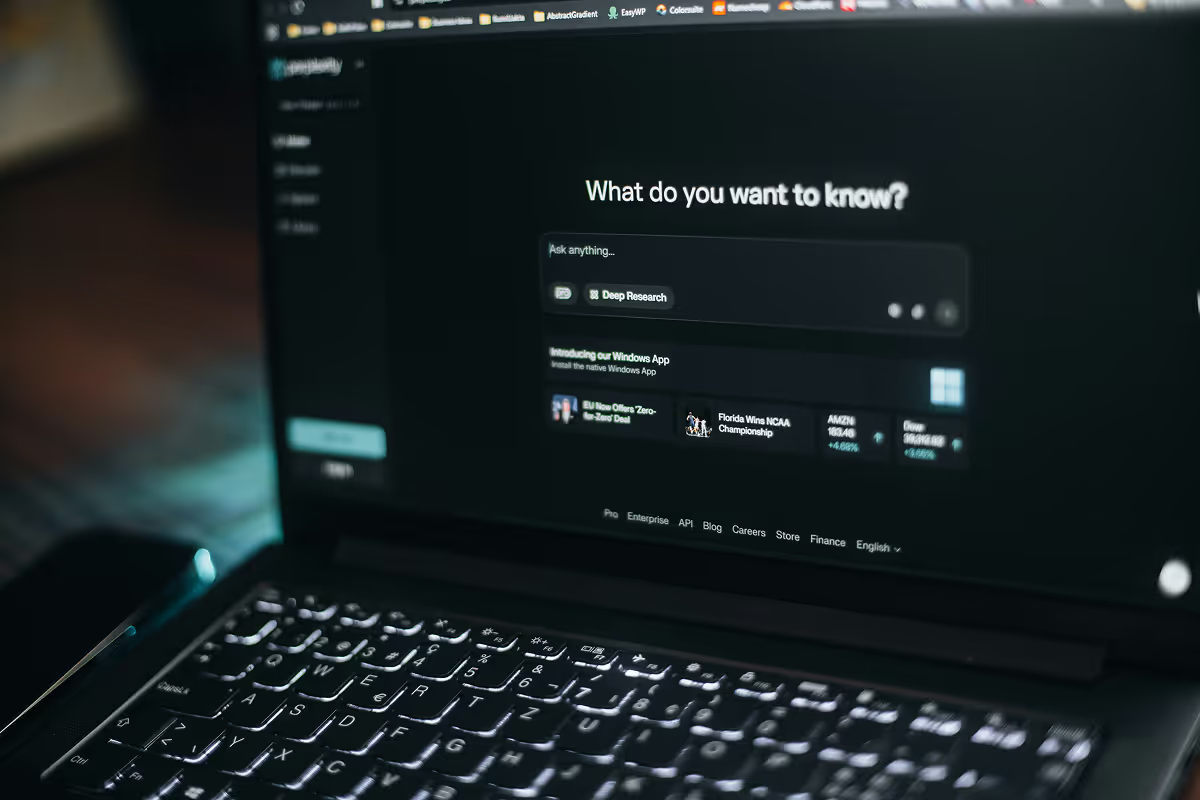
AEO stands for Answer Engine Optimization. Where traditional SEO is about ranking your website in a list of search results, AEO is about getting your content cited directly in the answers that AI tools generate.
Think about how search actually works now:
- Google's AI Overviews appear above organic results and summarize answers directly on the page
- Perplexity, Claude and ChatGPT search pull from websites to answer questions without the user ever clicking a link
- Voice search via Siri, Alexa, and Google Assistant reads a single answer out loud, not a list of options- Featured snippets on Google surface one direct answer at the top of results
All of these are answer engines. And they all have one thing in common: they reward content that gives a clear, direct, structured answer over content that tries to be clever or vague.
SEO got you onto the list. AEO gets you into the answer.
You might be thinking: "My customers are in Kelowna. They're searching locally. This is a big-tech thing."
It's not.
Local searches are where AEO has the most impact, and it's already happening. When a Kelowna homeowner asks ChatGPT "who does custom woodworking in Kelowna," or when someone voice-searches "best landscaping company near me" on the way home, they get one answer. Not ten. One.
The business that gets cited is the one that answered the question clearly in writing somewhere on the web. The businesses that didn't are invisible.
And here's the uncomfortable math: if you're not getting found in AI search, you're losing buyers before they even have a chance to land on your website. This isn't a conversion problem. It's a visibility problem happening upstream of everything else.

AI search tools don't rank websites the same way Google does. They look for content that:
Answers the question directly. If someone asks "how much does a website cost in Kelowna," the content that gets cited is the one that leads with a clear answer, not one that buries it in paragraph seven.
Is structured for readability. Short paragraphs, clear headings, and Q&A-style formatting make it easier for AI to extract and quote your content accurately.
Demonstrates expertise and trust. Google calls this E-E-A-T (Experience, Expertise, Authoritativeness, Trustworthiness). AI tools are trained on it. Pages that show real knowledge from a real source get cited. Generic, thin content gets skipped.
Uses schema markup. FAQ schema, LocalBusiness schema, and How-To schema give AI crawlers structured data to pull answers from. Most Kelowna business websites have none of this.
Loads fast and cleanly. AI crawlers and traditional crawlers both favor fast, clean sites. A slow WordPress site with plugin bloat is hard to index and easy to overlook.

You don't need to tear down your website. But you do need to make some specific changes. Here's where to start:
FAQ sections are the single highest-leverage AEO tactic for local businesses. Every question you answer directly in a structured Q&A format is a potential citation in an AI-generated answer.
Think about what your customers actually ask:
- "How long does a website project take?"
- "Do I need a Webflow developer or can I use Squarespace?"
- "What does web design cost for a small business in Kelowna?"
Answer each one in two to four clear sentences. No padding. No "great question." Just the answer.
"Welcome to [Your Business Name]" answers nothing. "Custom Cabinet-Making in Kelowna — Built to Order, 4-Week Lead Time" answers several questions in one sentence.
Every major heading on your site is a chance to answer a question your customer is already asking somewhere. Treat it that way.

Schema is code that sits in your page and tells search engines and AI tools exactly what your page is about. LocalBusiness schema tells Google and AI tools your name, address, phone number, and hours. FAQ schema marks up your Q&A sections so they can be pulled directly into answers.
On Webflow, this is done with custom code embeds. On WordPress, you can use a plugin. Either way, most small business sites have none of this set up, which is a straightforward win if you do it.
Most blog posts and service pages bury the answer. The intro rambles. The actual information doesn't appear until paragraph three or four.
AI tools trained on millions of documents have learned that the best answers front-load the key information. If you want to get cited, lead with the answer, then back it up with detail.
This is a writing habit more than a technical change, but it compounds over every page on your site.

AI search favors sources it can verify as credible and local. That means:
- Your Google Business Profile should be fully filled out and actively collecting reviews
- Your NAP (name, address, phone) should be identical across your website, Google, and any directories
- Local mentions — from news coverage, local business directories, or partner websites — signal to AI tools that you are a real, trusted business in this area
For Kelowna businesses, a mention from the Kelowna Chamber of Commerce or a local news outlet is worth far more in AEO terms than a generic backlink from a content farm.
Yes. They work together, not instead of each other.
SEO gets you into ranked results when people search the traditional way. AEO gets you into the answer when they don't click anything at all. The overlap is significant: fast sites, authoritative content, structured data, and local credibility help both.
The businesses that will win over the next three to five years are the ones building for both. The ones ignoring AEO are betting that search behavior isn't changing. That bet is getting worse by the month.

AEO is where SEO was in 2015. The businesses that understood SEO early built search visibility that compounded for years. Their competitors caught on later and spent twice as much to close the gap.
The same thing is happening now with AI search. In the Kelowna market, almost no small businesses are actively optimizing for answer engines. That gap won't last.
If you want to be the business that gets cited when a potential customer asks an AI tool who to call, the time to set that up is now, not after AI search captures 40% of queries.
Book a free 30-minute audit. We'll look at your content structure, schema markup, and how your site shows up in AI-generated searches — and give you a clear list of what to fix first.
Studio.909 is a Kelowna-based Webflow design agency. We help BC small businesses figure out where they're losing customers — and fix it.
.avif)


